Pass Interference in High School Football: The Rule in Plain English
Pass interference rules in high school football, in plain words: when restrictions start, what is a foul, and how penalties differ from college and the NFL.
The short answer
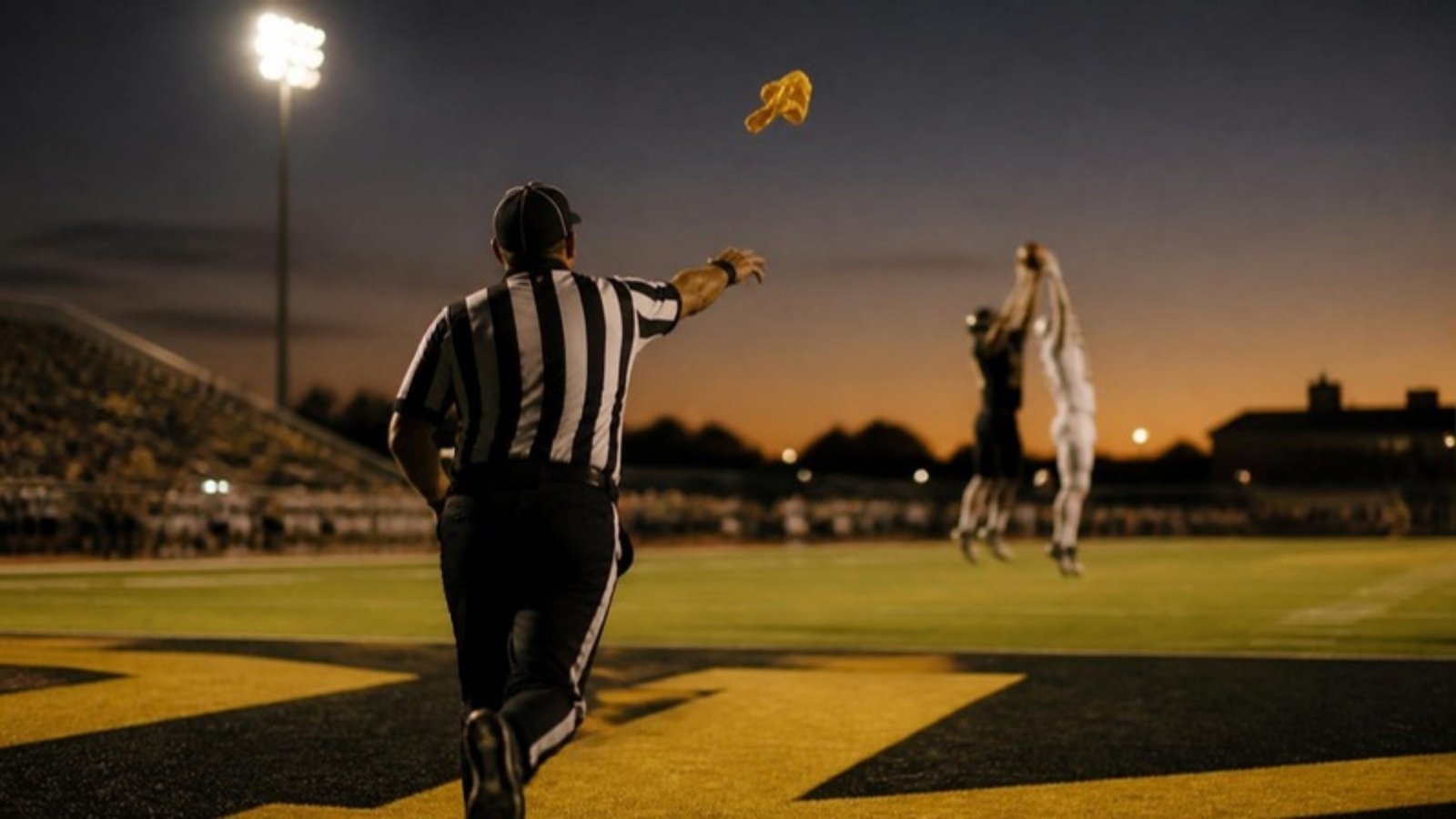
In high school football, pass interference is an act beyond the neutral zone that interferes with an eligible player's chance to move toward, catch or bat a legal forward pass. Under NFHS rules it is 15 yards from the previous spot for either team, and the down is replayed. There is no automatic first down and no loss of down.
Facts checked October 21, 2026. Rules and prices change; the sources are linked at the end.
In this post
This guide is for high school coaches, athletic directors and booster club members who want to know what the flag on a pass play means. In high school football, pass interference is an act beyond the neutral zone (past the line of scrimmage) that interferes with an eligible player’s chance to move toward, catch or bat a legal forward pass. Under National Federation (NFHS) rules, it is 15 yards from the previous spot for either team, and the down is replayed: no automatic first down for the offense, and no loss of down for the passing team.
The Rule in Plain Words
The NFHS rule is 7-5-10 in the 2026 NFHS Football Rules Book. The WIAA’s pass interference guide for officials breaks it down the same way.
Three conditions have to be true
- A legal forward pass crosses the neutral zone. If a defender touches the pass in or behind the neutral zone, the pass interference rules no longer apply on that play.
- The act happens beyond the neutral zone. The neutral zone is the space between the two lines of scrimmage, as wide as the length of the ball.
- The act interferes with an eligible player’s chance to move toward, catch or bat the pass. The key is that a player’s movement is restricted. Contact by itself is not enough.
When the restrictions start and stop
- Defense: from the moment the ball leaves the passer’s hand until any player touches it.
- Offense: from the snap until the ball is touched. So offensive pass interference can happen before the throw.
- Incomplete pass: once the pass is incomplete, the restrictions end for everyone.
One detail coaches miss: every defensive player counts as an eligible receiver, so an offensive player can interfere with any defender who is trying to get to the ball.
What Is and Is Not Pass Interference
Defensive pass interference
The WIAA guide lists six kinds of defensive interference against an eligible receiver:
- Arm bar: an arm across the receiver’s body that holds them back.
- Hold: grabbing the receiver, often the arm, so they cannot reach the ball.
- Not playing the ball: no real try for the ball, often not looking back, with contact that slows the receiver or knocks them off their path.
- Playing through the back: going through the receiver’s back to get to the ball.
- Hook and twist: hooking an arm around the waist or shoulders and turning the receiver.
- Cutoff: moving into the receiver’s path to block their way to the ball, even while looking back.
Offensive pass interference
- Blocking downfield before the pass is touched: the pick play. It is a foul when the block happens beyond the neutral zone while the restrictions are on.
- Pushing off: shoving a defender away to get open. This is the most common type.
- Driving through a defender: running through a defender who has already set up, so they cannot play the ball.
What is not pass interference
- Two or more players bumping while all of them make a real effort to move toward, catch or bat the ball.
- An offensive lineman blocking a defensive lineman right at the snap, as long as the contact does not continue past the expanded neutral zone, which runs up to 2 yards beyond the defensive line.
- Contact by a defender that is clearly away from where the pass is going.
- Face guarding with no contact. The NFHS removed it in the 2017 rules changes (posted by the New Mexico Activities Association).
- Defensive contact before the pass, or against a receiver who is not the target. That can still be a foul, but it is illegal use of hands or holding, a 10-yard penalty, not pass interference.
Catchable or uncatchable
At the high school level, whether the pass was catchable does not decide the call. The NFHS rule has no catchable-ball condition. In a 2016 “Be the Referee” segment, the Michigan High School Athletic Association said the same thing: if the contact is ruled pass interference, the foul stands regardless of the quality of the pass.
High School vs College vs NFL Penalties
| Level | Defensive pass interference | Offensive pass interference |
|---|---|---|
| High school (NFHS) | 15 yards from the previous spot, replay the down. No automatic first down since 2013. | 15 yards from the previous spot, replay the down. No loss of down since 2013. |
| College (NCAA) | See the NCAA rule book for the full enforcement. | 10 yards, starting with the 2026 season. It was 15 yards before that. |
| NFL | First down at the spot of the foul. A foul in the defense’s own end zone puts the ball on the 1-yard line when the previous spot was outside the 2. | Loss of 10 yards. |
Sources: the 2026 NFHS Football Rules Book, 2013 NFHS rule changes (WIAA), the NCAA’s March 2026 announcement, the NCAA playing rules page and the NFL Rulebook.
The big difference is the spot. In the NFL, the ball goes to the spot of a defensive foul, so a foul deep downfield can move the ball a long way. In high school, the defense gives up 15 yards from where the play started, no matter how far downfield the foul happened. The 15 yards can still carry the ball to or past the line to gain, and then the offense has a first down. It is just not automatic.
Myths That Start Arguments
- “Both players can play the ball, so no foul.” Half right. Contact between players who are both making a real try for the ball is not a foul. But that does not cover an arm bar, a hold, a cutoff or going through the back.
- “That pass was uncatchable.” Not a factor in high school. The flag stands.
- “Pass interference is an automatic first down.” Not in high school since 2013.
- “He was face guarding.” With no contact, not a foul in NFHS rules since 2017.
- “Any contact is interference.” No. The call is about interfering with a player’s chance to get to the ball, beyond the neutral zone, while the restrictions are on.
Three Example Plays
These are made-up plays to show how the rule works. The yard lines are examples only.
- Back-turned corner. Second and 10 at the offense’s own 30. On a deep out, the corner never turns his head, and the receiver runs into his raised arms 20 yards downfield and is knocked off his route. That is defensive pass interference, the “not playing the ball” type. Enforce 15 yards from the previous spot: the ball goes to the 45, which is past the line to gain at the 40, so it is first and 10. Change it to third and 20 at the 20, and the same foul puts the ball at the 35, short of the line to gain at the 40: third and 5.
- Pick play in the flat. First and 10 at midfield. While the ball is in the air to the running back, the slot receiver blocks the back’s defender five yards downfield. That is offensive pass interference. Enforce 15 yards from the previous spot, and replay the down: first and 25 at the offense’s own 35. No loss of down.
- Jump ball. A deep ball near the sideline. The receiver and the safety both turn, look for the ball and go up together. Their arms tangle and the ball falls incomplete. Both made a real effort to reach the ball, so there is no foul. If the safety had grabbed the receiver’s arm before going up, that would be defensive pass interference of the “hold” type.
The Signal and the Rule Book
Pass interference is signal 33 in the NFHS rule book’s signal chart. NFHS rule books are copyrighted, so this post paraphrases the rule. For exact wording, get the current book from the NFHS or your state association. Youth leagues may use their own rules, so ask your league.
Common Questions
Is pass interference an automatic first down in high school football?
No. Since 2013, NFHS rules have not given an automatic first down for defensive pass interference. The penalty is 15 yards from the previous spot, and the down is replayed. If those 15 yards carry the ball to or past the line to gain, the offense gets a first down that way.
Does the pass have to be catchable for pass interference in high school?
No. The NFHS rule has no catchable-ball condition, and the Michigan High School Athletic Association has explained it the same way. If the contact is ruled pass interference, the flag stands no matter how bad the throw was. The question is whether the act restricted the receiver, not whether the receiver would have caught it.
When does pass interference start for the defense?
For the defense, the restrictions begin when the ball leaves the passer’s hand and end when any player touches it or the pass falls incomplete. Before the throw, a defender who grabs a receiver can be flagged for illegal use of hands or holding instead, a 10-yard foul. The contact also has to happen beyond the neutral zone to be pass interference.
Can offensive pass interference happen before the ball is thrown?
Yes. For the offense, the restrictions start at the snap and run until the pass is touched. A receiver who blocks a defender beyond the neutral zone before the pass is touched, the classic pick play, can be flagged for offensive pass interference even if the quarterback has not thrown yet. The penalty is 15 yards from the previous spot.
Is face guarding a penalty in high school football?
Not by itself. In 2017, the NFHS removed non-contact face guarding from the pass interference rule. A defender can wave a hand in front of a receiver’s face while trying to reach the ball. Add contact that restricts the receiver, and it can still be pass interference.
Does offensive pass interference cost a down in high school?
No. The loss of down for offensive pass interference was removed in 2013. The penalty is 15 yards from the previous spot and the down is replayed. For example, first and 10 at midfield becomes first and 25 at the offense’s own 35. College and the NFL use 10 yards.
Do youth football leagues use the same pass interference rule?
Not always. A youth league may play NFHS rules with changes, or its own rules, and the penalty yardage can differ. Ask your league for its rule sheet before the season, and make sure your coaches and officials are working from the same one.
If you schedule your own officials, it helps to keep everyone in one place. See how referees and umpires work in MCM360 Sports, or use the Club Academy to write a five-minute lesson on your league’s rules for coaches and parents.
Sources
- 2026 NFHS Football Rules Book (Rules 2-28, 5-2, 7-5 and 9-2)
- General Principles: Pass Interference, Rule 7-5-10 (WIAA)
- NFHS Releases 2013 Football Rule Changes (WIAA)
- 2017 NFHS Football Rules Changes (New Mexico Activities Association)
- Be the Referee: Uncatchable Pass (MHSAA, 2016)
- NFL Video Rulebook: Defensive Pass Interference
- NFL Video Rulebook: Offensive Pass Interference
- NFL Rulebook (penalty summary)
- 2025 Rulebook Part 2 (NFL.com penalty tables)
- Changes to penalty structure for targeting in DI football approved (NCAA.org, March 19, 2026)
- NCAA Football Playing Rules

President and head coach of the Manitowoc Chiefs Youth Football Club, a WIAA Master Official in football, and the builder of MCM360 Sports. Have a question this post didn't answer? Ask him.