Youth Football Equipment Checkout: Getting Gear Back
A plain plan for youth football equipment checkout: a sign-out log, a family agreement, turn-in day, missing-gear options and helmet reconditioning.
The short answer
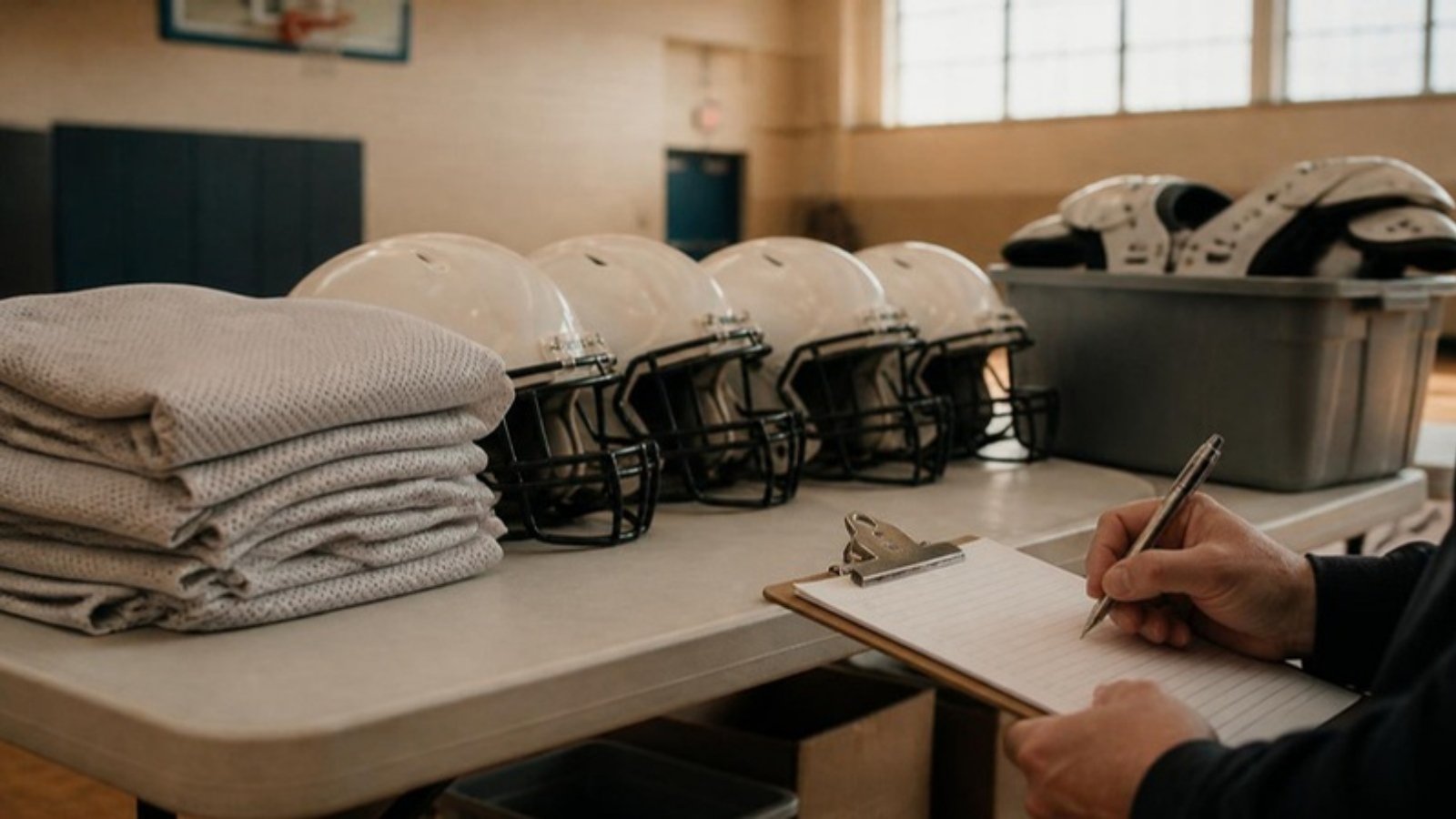
Write down exactly what each player takes on hand-out day, including size, number and condition, and have a parent sign for it. Then run one organized turn-in day and apply a missing-item policy your board set before the season, such as reminders, a replacement fee or holding next season's registration.
Facts checked October 11, 2026. Rules and prices change; the sources are linked at the end.
In this post
This is for the equipment manager, board member or volunteer coach who hands out helmets, pads and uniforms in August and then spends the winter chasing them. The short answer: youth football equipment checkout works when you write down exactly what each player took on hand-out day, have a parent sign for it, and run one organized turn-in day with a policy for missing items that your board decided before the season started. Below: a sample checkout log, sample agreement wording, a return day plan and options for missing gear.
Why Gear Goes Missing
Gear usually goes missing in ordinary ways, not through theft.
- Nobody wrote it down. “Helmet” is not enough. You need to know which helmet.
- Swaps during the season. A player trades shoulder pads with a teammate for a better fit, and now both records are wrong.
- The season ends with no plan. The last game ends, families scatter, and gear sits in a garage until spring.
- No consequence. If nothing happens, some gear stays home.
Set Up a Checkout Record at Hand-Out
The record you make on hand-out day is the whole system. For every item, write down:
- Item: helmet, shoulder pads, jersey, pants, belt, or whatever your club issues.
- Size: for reissuing and ordering.
- Number or serial: a jersey number, a helmet serial number, or an inventory number you write on a tag or piece of tape inside the item.
- Condition at hand-out: new, good, fair, or a short note like “scuff on left side.”
- Who signed: the parent or guardian name and the date.
Number everything before hand-out day
Use the serial number on each helmet’s label if it has one. For anything without one, give each piece your own inventory number before the season. Otherwise two size-medium pads look exactly alike.
Sample checkout log
An example page. The names and numbers are made up.
| Player | Item | Size | Number / Serial | Condition Out | Signed By / Date | Returned / Condition In |
|---|---|---|---|---|---|---|
| Player A | Helmet | Youth M | Serial on back label | Good | Parent A, Aug 3 | |
| Player A | Shoulder pads | Youth M | SP-014 | Good | Parent A, Aug 3 | |
| Player A | Game jersey | YL | #22 | New | Parent A, Aug 3 | |
| Player B | Helmet | Youth L | Serial on back label | Fair, scuff right side | Parent B, Aug 3 | |
| Player B | Game pants | YXL | GP-031 | Good | Parent B, Aug 3 |
Leave the last column empty until turn-in day. If players swap gear, update both rows that day.
The Equipment Agreement Families Sign
The log says what a family has. The agreement says what they promised to do with it. Keep it short, have a parent sign it at hand-out, and give them a copy.
Sample wording to adapt. It is not legal advice. Have your board review it, and check whether your league has its own form.
Equipment Agreement (sample)
My player has received the club equipment listed on the checkout log, with the sizes, numbers and condition shown. I understand this equipment belongs to the club and is loaned for this season only.
I agree to return every item, cleaned, on the turn-in date the club announces, or sooner if my player leaves the team. I will not paint, add stickers to, alter or lend out any equipment.
I understand the club’s policy for items not returned or returned damaged beyond normal wear, as written in the club handbook and adopted by the board. That policy may include a replacement fee and holding future registration until items are returned or settled.
Parent or guardian name, signature and date.
The line about not painting or adding stickers matters for helmets. One manufacturer’s care guide, the Riddell Victor helmet care guide, tells owners not to remove helmet labels, to use only its own paint systems, and warns that common substances can reduce protection without visible damage.
Return Day Logistics
Pick one turn-in day and announce it before the season ends. Right after the last game or the end-of-season party works well, while families are still around.
Set up a turn-in station
- One table per item type: helmets, shoulder pads, pants and belts, jerseys.
- The checkout log at the first table. A volunteer finds the player and checks off each item as it comes in.
- Bins or racks labeled by size, so returned gear is sorted for storage on the spot.
- A repair bin for anything broken.
Check condition as it comes in
Compare each item to the condition written at hand-out. Normal wear is expected. Note real damage in the log right then, with the parent present. Do not settle disputes at the table; let the board apply the policy later.
Ask for clean gear
Tell families ahead of time that jerseys and pants should be washed, and pads wiped out and dry. Damp pads in a bin will smell by spring.
Offer a second drop-off time for families who miss the main day, and name one contact person for late returns.
What to Do About Missing Items
Decide the policy before the season, not after something is missing. A board vote, written in the handbook and repeated in the agreement, is fair and keeps it from feeling personal. These are options your board decides on. What fits depends on your league and state; this is not legal advice.
Option 1: Reminders first
A reminder is often all it takes. Send a friendly message listing exactly which items are still out, then a second reminder and a phone call.
Option 2: A replacement fee
The board can set a replacement fee for each item, usually close to what the club would pay to replace it. Publish the amounts in advance, and decide who can approve a hardship waiver.
Option 3: Hold next season’s registration
Some clubs do not let a player register for the next season until the gear is returned or the fee is paid. It only works if it was in the policy families signed.
Whatever you choose, keep it private between the club and the parent, never in a team group chat.
Cleaning, Storage and Helmet Reconditioning
- Wash jerseys and pants according to their tags.
- Wipe out pads and let them dry fully before they go into bins.
- Store gear indoors and dry, sorted by size.
Helmets have their own rules
The NOCSAE recertification page explains that reconditioning means inspection, cleaning, sanitizing and repair, and recertification means retesting the helmet. It says leagues and owners are responsible for it, that equipment should be sent right after the season ends, and that the process takes six or more weeks on average.
NOCSAE’s general recertification page says the interval depends on each manufacturer, is based on years since the last recertification rather than use, and that even helmets not used last season may need it. NAERA reconditioners will not recondition or recertify helmets 10 years old or older. Riddell’s care guide linked above recommends yearly reconditioning by a factory authorized reconditioner and says proper maintenance requires it at least every two years. The same guide says to use only Riddell helmet cleaner, since commercial cleaners may damage the shell or liner. Check the manufacturer guidance for each helmet model you own.
Take Inventory for Next Season
While gear is sorted, count it.
- Count usable items by type and size.
- List what is out for reconditioning, and when it should come back.
- List what is missing, damaged or past its useful life.
- Give the board an order list with sizes and quantities so it can budget before registration opens.
Keep the season’s checkout log. It shows which sizes ran short and gives the next equipment manager a head start.
Common Questions
What should I write down when we hand out football equipment?
For each item, record the item type, size, a number or serial, its condition, and the name of the parent who signed for it with the date. Use a helmet’s serial number if it has one, and write your own inventory number inside pads and pants before hand-out. That lets you match every returned item to the player who took it.
Do parents really need to sign for youth football gear?
A signature is not required everywhere, but it helps a lot. It shows the family saw the list of what they received and agreed to return it. It also connects them to your missing-item policy, so a replacement fee or registration hold later is not a surprise. Have your board review the wording.
When should we hold equipment turn-in day?
Hold it as close to the last game as you can, while families are still coming around. Right after the final game or the end-of-season party works for many clubs. Announce the date before the season ends, and offer a second drop-off time for families who cannot make it. NOCSAE says helmets should go out for reconditioning right after the season ends.
Can our club charge a fee for gear that is not returned?
That is your board’s decision, and rules can depend on your league and state. If you use a replacement fee, set the amounts in advance, put them in the handbook and the signed agreement, and decide who can approve a waiver.
Can we stop a kid from registering next year if they kept their equipment?
Some clubs hold next season’s registration until gear is returned or the replacement fee is paid. It is an option your board can adopt, not a requirement, and you should check with your league first. It works best when it was written in the policy and the agreement the family signed, and when your registrar has an accurate list.
How often do youth football helmets need to be reconditioned?
It depends on the manufacturer. NOCSAE says the interval varies by manufacturer and is counted by years since the last recertification, not by use. Riddell’s helmet care guide recommends reconditioning every year and at least every two years. Check the guidance for each helmet model your club owns, and send helmets out right after the season.
How old is too old for a football helmet?
According to NOCSAE, NAERA reconditioners will not recondition or recertify helmets that are 10 years old or older, and in most cases football helmets can be recertified until they reach that age. Check the date label inside each helmet during inventory and budget for replacements.
A paper log and a signed sheet do the job. If you would rather hand out gear player by player, track sizes and run turn-in day from a phone, see how equipment works in MCM360 Sports. The signed agreement can also live in your club handbook.
Sources

President and head coach of the Manitowoc Chiefs Youth Football Club, a WIAA Master Official in football, and the builder of MCM360 Sports. Have a question this post didn't answer? Ask him.