Robert’s Rules of Order for Small Boards: The Short Version
Robert's Rules for small boards, in plain words: motions, amendments, voting, tabling vs postponing, executive session, plus a printable cheat sheet.
The short answer
Robert's Rules has relaxed procedures for boards of about a dozen members or fewer: members stay seated, motions need no second, discussion can come before a motion, and the chair can debate and vote. Your bylaws still come first, and decisions still have to be made in a meeting with a quorum.
Facts checked October 22, 2026. Rules and prices change; the sources are linked at the end.
In this post
If you sit on a youth club board of 5 to 12 people, you do not need the full formality of Robert’s Rules of Order. The book itself sets out relaxed rules for small boards: you can stay seated, motions do not need a second, the chair can debate and vote, and you can talk an idea through before anyone makes a motion. Below are the moves a club board actually uses, plus a one-page cheat sheet.
Everything here follows Robert’s Rules of Order Newly Revised, 12th edition, which the official Robert’s Rules website lists as the current edition, released in September 2020. One caution first: the official site’s FAQ notes that these are default rules. Your bylaws, any special rules your board adopted, and state law come first. If your bylaws say something different, follow your bylaws.
The Small Board Rules in Plain Words
According to parliamentarian Jim Slaughter’s summary of the small board rules, these relaxed procedures apply when about a dozen or fewer members are present:
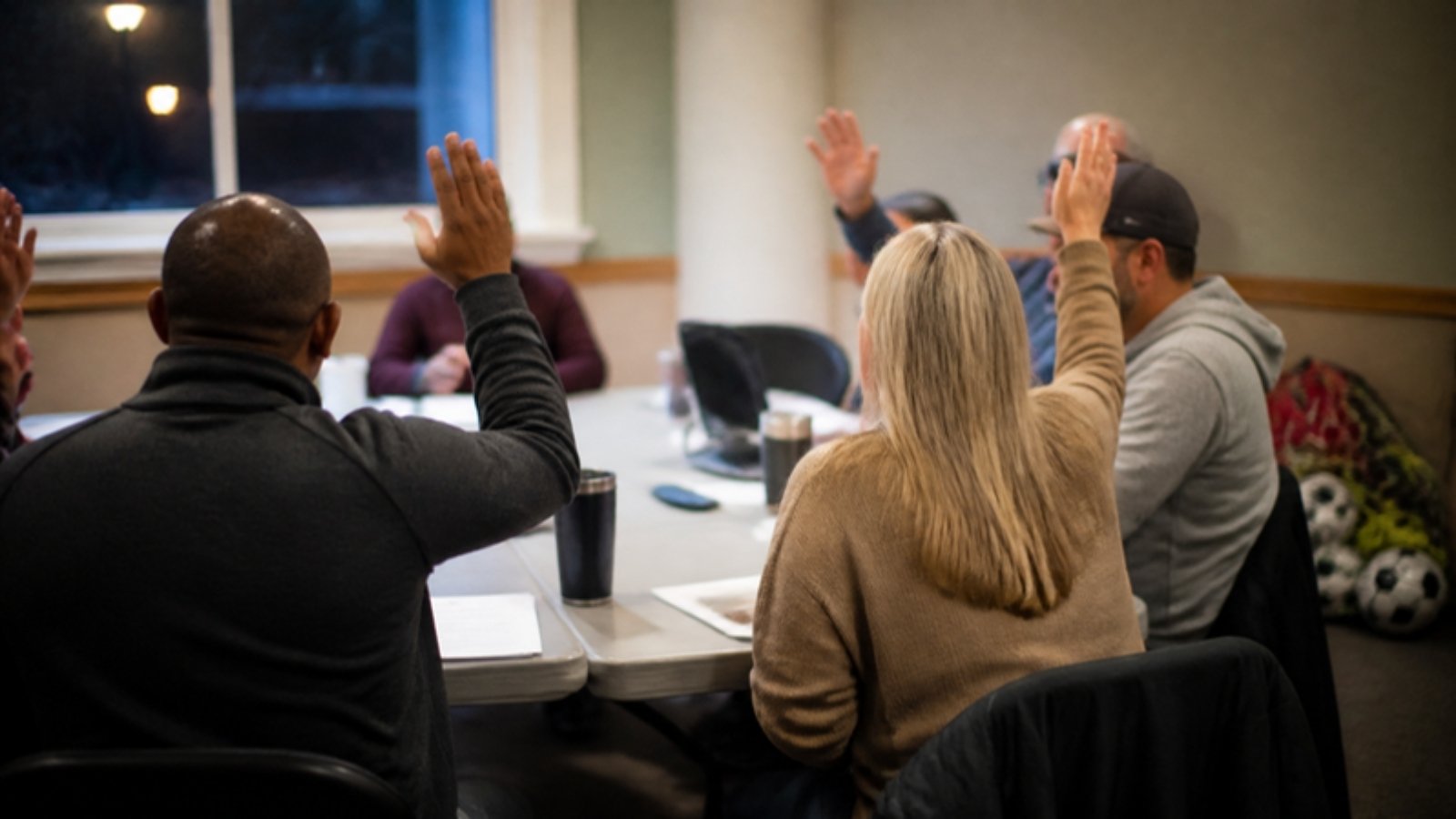
- No standing. Raise a hand to get the floor, and stay seated while you speak or make a motion.
- No second needed. A motion can go straight to discussion.
- Talk first, move later. The board may discuss a subject while no motion is pending.
- Sometimes no motion at all. When a proposal is clear to everyone, the chair can take a vote on it without a formal motion.
- No limit on speaking. Members can speak more than once on the same question.
- The chair is a full member. The chair may make motions, speak in debate and vote on every question.
- Show of hands. Votes are often taken by raising hands.
Slaughter also notes that a small board should get more formal on important or controversial matters.
One rule does not relax: decisions are made in a meeting with a quorum. The official FAQ says approval collected from members one at a time is not board action, and video or phone meetings need bylaw authorization.
Making a Motion and Amending It
The basic path of a motion
- A member says, “I move that we…” and states the proposal.
- In a small board, skip the second. If your board is larger or more formal, the chair asks, “Is there a second?”
- The chair restates the motion so everyone knows exactly what is on the table.
- The board discusses it.
- The chair asks, “Are you ready for the question?” and takes the vote.
- The chair announces the result: adopted or lost.
Once the chair states a motion, it belongs to the board, not its maker. So the official FAQ calls the “friendly amendment” a mistake: the chair still asks the board. If nobody objects, the change is adopted. If one person objects, it is voted on like any amendment.
Amendments
To change a motion, say “I move to amend the motion by…” and name the words to add, remove or replace. An amendment needs a majority vote. You can also amend an amendment, but that second-level change has to be about the first amendment, not some other part of the motion. Vote on the amendment first, then on the main motion as it now reads.
For example, a motion to buy 40 soccer balls for $600 could be amended to 30 balls for $450.
Voting Methods and What Counts as a Majority
Most club boards use one of these:
- General consent. The chair asks, “Is there any objection?” Silence means it passes. One objection means a regular vote. Use it for routine items like approving the minutes.
- Voice vote. “Those in favor, say aye. Those opposed, say no.”
- Show of hands. The normal method in a small board and the easiest to count.
- Ballot. Use it when the bylaws require it, often for elections. If the bylaws require a ballot, a voice vote cannot replace it.
A majority means more than half of the votes cast. The official FAQ warns against saying “50 percent plus one.” Its example: with 17 votes cast, 9 to 8 is a majority. Abstentions are not votes. When your rule is a majority of votes cast, abstaining has no effect on the result. If your bylaws require a majority of members present, an abstention works the same as a no.
Point of Order, Tabling and Postponing
Point of order
If you think the board is breaking its own rules, say “Point of order.” You can interrupt a speaker to do it, and it needs no second. The chair rules on it. If a member disagrees with that ruling, they can appeal, and the board decides.
Tabling is not the same as postponing
This is the most misused motion in youth sports boards. Here is the difference:
- Lay on the table sets a motion aside for a short time because something urgent came up. It is not debatable and needs a majority. According to the official FAQ, it may not be used to kill a motion.
- Postpone to a certain time moves the motion to a later point, such as the next meeting. It is debatable and needs a majority. This is usually what people mean when they say “table it until next month.”
- Postpone indefinitely kills the motion without a direct vote on it. It needs a majority.
Shouting “Question!” does not end debate. A member must move the previous question, which needs a two-thirds vote.
Executive Session
Executive session is the closed part of a meeting. Non-members leave, and what is said stays confidential. According to the official FAQ, the board can still vote in executive session. Club boards use it for a coach complaint or a player discipline matter.
- Go into it by majority vote or general consent. The chair should name only the general topic, such as “a personnel matter.”
- Record what was decided, not what was said. Slaughter notes those minutes are available only to people who had the right to attend.
- If your group is part of a public school or falls under state open meeting rules, those laws may limit closed sessions. Check with your district or state association.
For more on agendas and running the meeting itself, see how to run a youth sports board meeting.
One-Page Cheat Sheet
Print this and keep it with the agenda. The vote column follows a 12th edition motions chart.
| You want to… | Say this | Vote needed |
|---|---|---|
| Propose something | “I move that…” | Majority |
| Change a motion | “I move to amend the motion by…” | Majority |
| Approve something routine | Chair: “Is there any objection?” | None, unless someone objects |
| Move it to the next meeting | “I move to postpone the motion to our next meeting.” | Majority |
| Set it aside for something urgent | “I move to lay the question on the table.” | Majority, no debate |
| Kill it without a direct vote | “I move to postpone the motion indefinitely.” | Majority |
| End debate | “I move the previous question.” | Two-thirds |
| Send it to a committee | “I move to refer the motion to…” | Majority |
| Flag a broken rule | “Point of order.” | None, the chair rules |
| Disagree with the chair’s ruling | “I appeal the decision of the chair.” | Majority, a tie sustains the chair |
| Retake an unclear voice or hand vote | “I call for a division.” | None, the vote is retaken standing |
| End the meeting | “I move to adjourn.” | Majority |
Your secretary records each motion and its result in the minutes. If you need a format, use the board meeting minutes template.
Common Questions
Do motions need a second in a small board?
No. Under Robert’s Rules, a board with about a dozen or fewer members present does not need seconds for motions. A second only shows that at least one other person wants to discuss the idea. Even in a larger meeting, a missing second does not undo a motion once the board has debated or voted on it. If your bylaws require seconds, follow your bylaws.
Can the board president vote on everything?
Yes, in a small board. The official Robert’s Rules FAQ says the chair of a board of roughly a dozen or fewer members may make motions, speak in debate and vote on every question. The rule that the chair votes only to break a tie is a myth.
What is the difference between tabling and postponing a motion?
Tabling sets a motion aside briefly so the board can deal with something urgent, and it cannot be debated. Postponing to a certain time moves the motion to a set point, like the next meeting, and it can be debated. If you mean “let’s decide this next month,” the right motion is to postpone. Neither one should be used to quietly kill a proposal.
Can our board vote by email or group text?
Usually not. The official Robert’s Rules FAQ says collecting approval from each member one at a time does not count as board action, because there was no meeting where members could discuss it together. Email votes are generally valid only when your bylaws allow them. If you had to act fast, the board can ratify that decision at its next regular meeting.
Do abstentions count as no votes?
It depends on your vote rule. When a motion needs a majority of the votes cast, an abstention has no effect because it is not a vote. When your bylaws require a majority of the members present, or of the whole board, an abstention has the same effect as a no. Check which rule your bylaws use before a close vote.
Can we vote in executive session?
Yes. According to the official Robert’s Rules FAQ, executive session is confidential but otherwise has no special limits, so the board can debate and vote there. Record what the board decided, not who said what. Those minutes are for the people who had a right to attend. If your club falls under open meeting laws, check what your state allows.
What does “point of order” mean in a meeting?
A point of order is how any member says the board is not following its rules. You can interrupt a speaker to raise it, and no second is needed. The chair decides whether you are right. If a member disagrees with the chair’s ruling, they can appeal, and the board votes on it.
A printed cheat sheet works fine. If you would rather keep the agenda, attendance with a live quorum count and the minutes in one place, see how board meetings work in MCM360 Sports. You can also list your board members, open seats and next meeting date on a board page on your club website.
Sources
- FAQs - Official Robert's Rules of Order Website
- Books - Official Robert's Rules of Order Website
- Board Procedures Versus a Membership Meeting or Convention, Jim Slaughter
- Meeting Myths and Robert's Rules Explained, Jim Slaughter
- Phrases for the Presiding Officer, Jim Slaughter
- Executive Session and Closed Meeting Issues, Jim Slaughter
- Parliamentary Motions Guide, Robert's Rules 12th Edition, Jim Slaughter
- Brainteasers 1, Updated to Robert's Rules 12th Edition, Jim Slaughter

President and head coach of the Manitowoc Chiefs Youth Football Club, a WIAA Master Official in football, and the builder of MCM360 Sports. Have a question this post didn't answer? Ask him.